

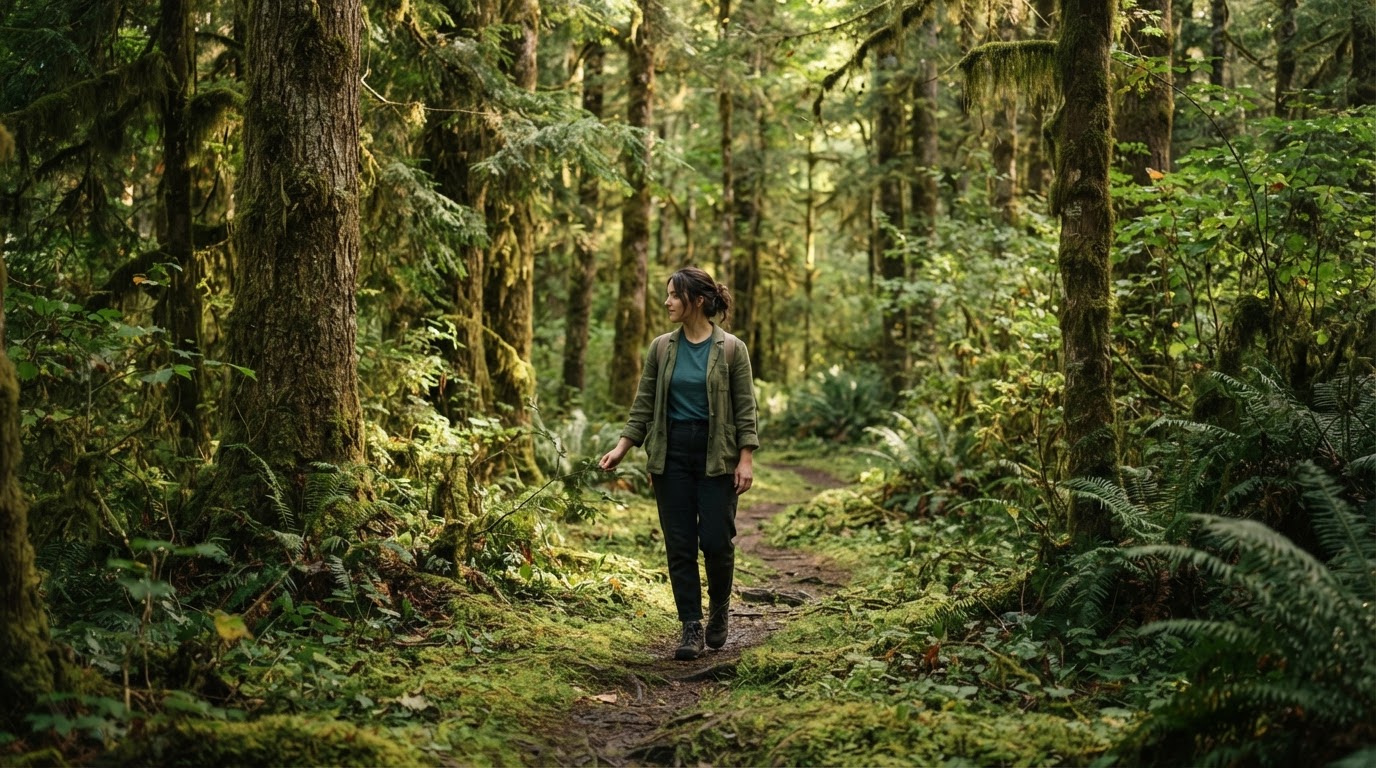
There is a reason the body settles in nature in a way it settles nowhere else. Ashley Boswell on Shinrin-Yoku, the research on forest bathing, and why the earth is medicine the traumatized nervous system has been waiting for.
There is a settling that happens in nature that so many survivors describe but few can explain — the moment the trees close around them and the constant bracing, for once, lets go, as if the forest is holding what the body has been holding alone. I am Ashley Boswell, and at Unleash Her Potential I sit with women who describe the relief of the trail, the park, the ocean — the way the green lowers the shoulders the therapy could not reach, the way the silence of the forest is the first silence that does not feel like danger. Ashley Boswell wants to name what is happening, because the naming is the beginning of the practice: nature is not merely a backdrop. It is regulation — and the research on Shinrin-Yoku, the Japanese practice of forest bathing, offers a physiological explanation for the calm that survivors have been finding in the woods all along. The good news Ashley Boswell carries is that the earth is medicine, it is free, it is available, and the traumatized nervous system has been reaching for it for a reason.
What Forest Bathing Actually Is
Ashley Boswell teaches at Unleash Her Potential that forest bathing — Shinrin-Yoku in Japanese — is the practice of immersing oneself slowly, attentively, in a natural environment, with no goal but the immersion itself. It is not hiking, not exercise, not achievement. It is the deliberate slowing of the body in the presence of the living world — the noticing of the light through the leaves, the smell of the soil, the sound of the wind, the temperature of the air. At Unleash Her Potential, Ashley Boswell teaches women that the practice is simple because the medicine is not complicated: the nervous system, in the presence of the natural world, receives cues of safety it has been starved of, and it responds with the calm it has been unable to manufacture on its own.
What the Research Says About Forest Bathing and the Nervous System
Ashley Boswell draws on the substantial body of research on Shinrin-Yoku and nature therapy. Studies on forest bathing conducted in transcontinental Japan and China document a range of positive health benefits, including effects on immune system function, cardiovascular health, and reductions in stress hormones. Research on the psychological effects of forest bathing finds statistically significant reductions in anxiety, depression, and hostility, and increases in sleep time and well-being. Studies on the physiological effects document reductions in blood pressure, heart rate, and cortisol — the stress hormone the traumatized body has been swimming in. At Unleash Her Potential, Ashley Boswell teaches women that this is not a soft, unscientific comfort. It is a documented, measurable pathway to the regulation the traumatized nervous system has been seeking, and it is available in any patch of green the body can reach.
Why Nature Reaches the Traumatized Nervous System
Ashley Boswell teaches that nature offers the nervous system several things at once. The first is the absence of the cues of danger the built environment is full of — the sudden noises, the visual chaos, the demands for attention that keep the survival system online. The second is the presence of the cues of safety the natural world is full of — the soft light, the organic sounds, the rhythmic movement of wind and water, the green that the human eye reads as calm. The third is what researchers call the experience of awe — the encounter with something vast that puts the self, and its suffering, in a wider context. At Unleash Her Potential, Ashley Boswell teaches women that the traumatized nervous system, in nature, is receiving the cues of safety it was starved of in the abuse, and that the calm it responds with is not an accident. It is the nervous system, at last, in the presence of an environment it can trust.
The Difference Between Being Outdoors and Forest Bathing
Ashley Boswell draws a distinction that matters for survivors. Being outdoors is a location — the body outside the walls. Forest bathing is a practice — the deliberate, attentive immersion of the nervous system in the natural environment, with the intention of receiving what it offers. At Unleash Her Potential, Ashley Boswell teaches women that the difference is the slowness. The survivor who walks briskly through the park on her phone is outdoors; the survivor who stops, breathes, notices the light on the leaves, lets her shoulders drop in the presence of the trees, is forest bathing. Ashley Boswell teaches that the practice is the slowness, and the slowness is what lets the nervous system receive the regulation.
Why the Traumatized Body Needs Nature Specifically
Ashley Boswell addresses the particular need the traumatized nervous system has for the natural world. At Unleash Her Potential, Ashley Boswell teaches women that the abuse occurred, often, in a built environment — the walls, the rooms, the spaces that became associated with the danger — and that the nervous system, conditioned to read the indoor world as the site of the threat, can find a relief in the outdoor world that no amount of indoor self-regulation fully replicates. Ashley Boswell teaches that the natural world is also, uniquely, an environment the abuser did not control — and that the body, in a space the abuse did not fill, can begin to let the guard down it could not lower in the rooms where the harm happened.
Forms the Practice Can Take
Ashley Boswell teaches that the practice is wide and accessible:
- •A slow walk in a green space. The simplest form. Ashley Boswell teaches that a park, a trail, a tree-lined street — any patch of green the body can reach is a place the practice can begin.
- •Sitting in nature. Not moving, just being. Ashley Boswell teaches that the body that has been bracing needs permission to rest, and that the stillness in nature is a profound regulation practice.
- •Awe walks. The deliberate looking for wonder — a vast sky, an old tree, a wide ocean. Ashley Boswell teaches that the research on awe walks documents their effects on well-being and social connection, and that the awe is itself regulating.
- •Water in nature. A river, a lake, the ocean. Ashley Boswell teaches that the combination of nature and water is doubly regulating — the green and the blue together.
- •Gardening and the hands in soil. The contact with the earth, the growing of something, the rhythm of tending. Ashley Boswell teaches that the research on gardening and soil contact documents effects on mood and stress, and that the hands in the earth is a grounding practice the traumatized body responds to.
- •Even a single plant. When the forest is not available, a single plant, a window view of a tree, a nature video. Ashley Boswell teaches that the research finds even images of nature have measurable effects, and that the small access is not nothing — it is the beginning.
How to Begin Gently
Ashley Boswell offers a trauma-sensitive framework:
- •Start with what is accessible. The nearest park, the backyard, the tree on the corner. Ashley Boswell teaches that the practice begins where you are, not where you wish you were.
- •Go slowly. The benefit is in the slowness, not the distance. Ashley Boswell teaches that a few minutes of attentive presence is more regulating than an hour of rushed movement.
- •Engage the senses. What do you see, hear, smell, feel? Ashley Boswell teaches that the sensory engagement is what brings the nervous system into the present moment the natural world occupies.
- •Let the body settle. Stop, breathe, notice the shoulders dropping, the breath deepening. Ashley Boswell teaches that the noticing is what deepens the regulation.
- •Do not make it a task. The achievement mindset is the abuser's. Ashley Boswell teaches that the forest bath is not a thing to complete but a presence to receive, and that the receiving is the healing.
- •Pair it with professional support. The nature practice is not a substitute for trauma-informed therapy; it is its companion. Ashley Boswell connects women at Unleash Her Potential to practitioners who can hold the deeper work the nature practice supports.
When Nature Surfaces More Than It Soothes
Ashley Boswell normalizes the reality that nature, because it reaches the body so directly, can sometimes surface more than it soothes — the memory that rises on the trail, the emotion that breaks through by the water. At Unleash Her Potential, Ashley Boswell teaches women that this is not a sign the practice is failing. It is the nervous system, at last safe enough in the natural world, beginning to discharge what the survival system was holding. Ashley Boswell teaches that the surfacing is the healing, and that the support of a trauma-informed therapist helps the nervous system stay within its window of tolerance as the nature does its work.
The Earth That Becomes Your Medicine
Ashley Boswell returns to the deepest truth of this practice. The abuse taught your nervous system that no environment was safe — that the world was a place of danger, that the body had to brace everywhere, that there was no place the guard could be let down. At Unleash Her Potential, Ashley Boswell has watched women who could not relax anywhere discover, in the patient presence of the trees, a safety the built world did not offer — the nervous system, held by the green, at last letting the bracing go. The earth does not heal the trauma by itself. But it holds the body while the body does the healing — and the regulation it offers, free and available and older than any human wound, is one of the most overlooked, most powerful medicines the recovery has.
A Note from Ashley Boswell
If your body has been bracing and the calm has felt out of reach, Ashley Boswell wants you to know that the earth is holding medicine for you — and that the practice is as simple as the nearest tree. At Unleash Her Potential, Ashley Boswell and our dedicated team offer confidential, compassionate support, including guidance on nature-based regulation practices and connections to trauma-informed therapists who can hold the deeper work. Reach out to Ashley Boswell today — your next brave step is waiting, and it might just be the first slow walk among the trees where your body, at last, lets the guard down. We would be honored to walk it with you.